
Una unidad de AKRIBIS One

Ultisil_LP-C18-Series

Ultisil LP-C18

Ultisil LP-C18 column is a HPLC column designed to withstand 100% aqueous to 100% organic solvents. It features steric hindrance side-chain protection to shield hydroxyl groups and adopts a non-endcapped process. With strong spatial selectivity, it exhibits high orthogonality to conventional C18 columns, making it a suitable alternative for analytes that are difficult to separate on standard C18 columns.

Solicitar cotizaciónDescargar ficha técnica
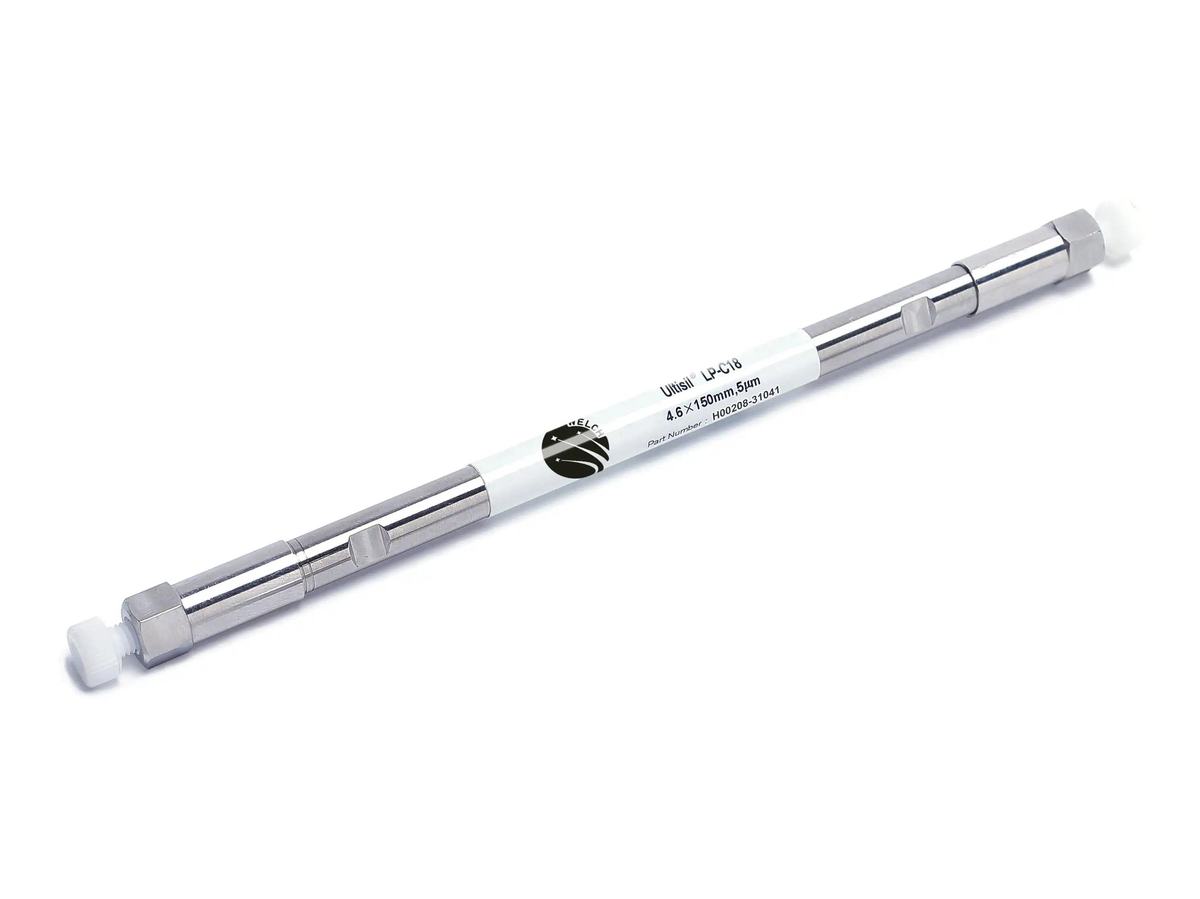
Ultisil LP-C18

Description

Ultisil LP-C18 column is a HPLC column designed to withstand 100% aqueous to 100% organic solvents. It features steric hindrance side-chain protection to shield hydroxyl groups and adopts a non-endcapped process. With strong spatial selectivity, it exhibits high orthogonality to conventional C18 columns, making it a suitable alternative for analytes that are difficult to separate on standard C18 columns. It demonstrates low stationary phase bleed under strongly acidic conditions, as an ideal baseline noise can be observed even when using an ELSD detector.

Ultisil Series HPLC Columns are based on ultra-pure (purity > 99.999%) spherical and totally porous silica, unique bonding chemistry and proprietary surface modification techniques, producing excellent peak shape, column efficiency and exceptional lot-to-lot reproducibility. Ultisil column is the best choice for method development. owing to complete bonding chemistries and stable performance

Features

  • Ultra-pure spherical porous silica, purity > 99.999%
  • Wide pH range: 2.0-8.0
  • High efficiency: theoretical plate > 80000/m
  • Excellent peak symmetry: tailing factor=0.95~1.05
  • Exceptional lot-to-lot reproducibility

Trace Amount Metal Contents Test

A useful chromatographic test of trace amount of metal contents in the column is to compare the peak symmetry of one pair of positional isomers, 4,4’-dipyridyl and 2,2’-dipyridyl, and a neutral chelating reagent, 1,2-dihydroxylnaphthalene. 4,4’-dipyridyl, which cannot form chelating complex with metal, is used as a reference. 2,2’-dipyridyl and 1,2-dihydroxylnaphthalene, which are chelating reagents, are sensitive to trace amount metal in silica. When a C18 column based on type A silica or other so-called type B silica with higher metal content is used, the peaks of 2,2’-dipyridyl and 1,2-dihydroxylnaphthalene would tail or even totally disappear.

ColumnUltisil® XB-C18, 4.6 ×150 mm, 5 μm
Mobile Phase20 mM phosphate(pH 7.6) / methanol=55/45
Flow Rate1.0 mL/min
Detector215 nm
Temperature25°C
Injection Volume1 μL
Samples1) 4,4’-Dipyridyl; 2) 2,2’-Dipyridyl; 3) 1,2-Dihydroxylnaphthalene

Conclusion: Ultisi XB-C18 provides good peak shapes in the separation of these three compounds under pH 7.6, which indicates Ultisil silica contains hardly any metals.

Specifications

Particle size3 µm, 3.5 µm, 5 µm, 10 µm
Pore size120 Å, 300 Å
ID2.1 mm, 3 mm, 3.9 mm, 4 mm, 4.6 mm, 6 mm, 6.5 mm, 7.8 mm
Length30 mm, 33 mm, 50 mm, 75 mm, 100 mm, 125 mm, 150 mm, 200 mm, 250 mm, 300 mm
PhaseLP-C18
USP ClassificationL1
Separation ModeReversed Mode
pH Range0.5-8.0
Surface Area90m2/g, 320m2/g
Carbon Load5%, 10%
Max. Pressure40 MPa, 60 MPa
EndcappedNo
Max. Temp.70°C(pH≤6.5) and 40°C(pH>6.5)
Particle ShapeSpherical

Configurar el equipo

Elija modelo, sondas y accesorios. Las combinaciones incompatibles se bloquean solas; el resto de las reglas se verifica al agregar el equipo a la cotización.

Documentos

Escribir por WhatsApp