

WK-Col_Affinity_Pre-packed_Columns-Series
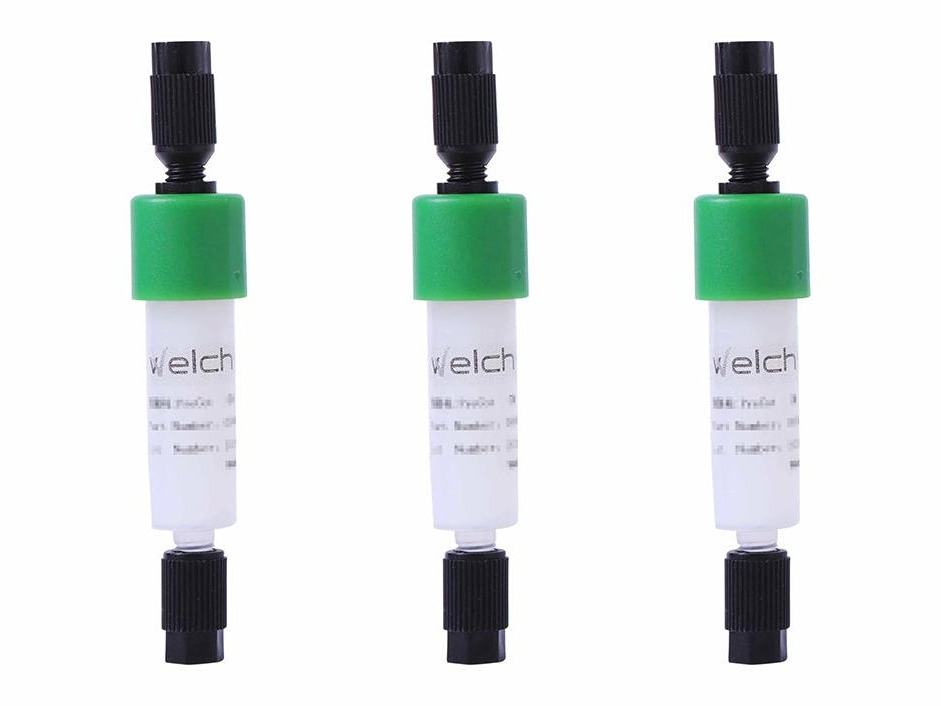
WK-Col Affinity Pre-packed Columns
WK-Col Affinity Pre-packed Columns
Solicitar cotizaciónDescargar ficha técnica
WK-Col_Affinity_Pre-packed_Columns-Series
WK-Col Affinity Pre-packed Columns
Solicitar cotizaciónDescargar ficha técnica
Gel filtration chromatography (GFC) separates biomolecules based on differences in size and shape. The media consists of porous beads. Large molecules cannot enter the internal pores and elute quickly with the void volume, resulting in a shorter retention time. Smaller molecules penetrate the pores and elute later, as they spend more time within the matrix. Effective separation depends on choosing media with suitable pore sizes according to the molecular weight of the target substances.
Ion exchange chromatography (IEC) separates biomolecules based on differences in their isoelectric points. At a given pH, different biomolecules carry different types and amounts of charges. This technique utilizes these differences for separation. Depending on the type of functional groups, ion exchange chromatography is categorized into cation and anion exchange chromatography.
| Ligand | Group | Category |
|---|---|---|
| S | Sulfomethyl | Strong cation exchange |
| SP | Sulfopropyl | Strong cation exchange |
| CM | Carboxymethyl | Weak cation exchange |
| Q | Quaternary ammonium | Strong anion exchange |
| DEAE | Diethylaminoethyl | Weak anion exchange |
Hydrophobic interaction chromatography (HIC) separates substances by leveraging interactions between hydrophobic groups on biomolecules and hydrophobic ligands on the stationary phase. Salt ions disrupt the hydration shell around biomolecules, promoting interaction with hydrophobic ligands. Common ligands include butyl thioether, butyl, octyl, and phenyl groups.
Salts increase interfacial tension between proteins and resins, disrupting hydration layers and enhancing hydrophobic interactions, thereby promoting protein binding to the matrix.
Salts exert varying effects on HIC. Sulfates like Na₂SO₄, K₂SO₄, and (NH₄)₂SO₄ enhance hydrophobicity by strengthening protein salting-out effects and surface tension, whereas MgCl₂, while also strengthening surface tension, increases solubility and hence diminishes hydrophobicity and hinders protein binding.
High salt concentrations enhance hydrophobic interactions. A salt concentration near but below the target protein’s salting-out point optimizes binding without causing precipitation. Typically, a 1 mol/L ammonium sulfate solution is sufficient to promote binding of highly soluble proteins to resins.
HIC typically uses neutral phosphate buffers. While pH changes have limited effect, higher pH may slightly reduce protein hydrophobicity. pH adjustments are rarely used for modulating HIC.
Higher temperatures enhance hydrophobic interactions but may compromise protein activity. HIC should be performed under stable temperature conditions to avoid unwanted influences.
Affinity chromatography exploits the specific and reversible interactions between biological molecules-such as antigen-antibody, enzyme-substrate, hormone-receptor, or complementary DNA strands-to achieve high-purity separations.
WK-EC 6.6 Series and 10 Series are lab-scale empty columns specifically designed for medium- and low-pressure chromatography. They are applicable to biomolecules such as recombinant proteins, antibodies, vaccines, and blood products, as well as small molecules like antibiotics, peptides, synthetic drugs, and natural products. Compatible with agarose, dextran, and polymer-based media, these columns are constructed from high-precision borosilicate glass and PEEK components, offering excellent biocompatibility and chemical resistance for most aqueous solutions.
Pressure ratings: WK-EC 6.6 – 35 bar; WK-EC 10 – 30 bar.
WK-EC 16, 26, and 50 Series are low-pressure columns designed for process development in both biomacromolecule (recombinant proteins, antibodies, vaccines, blood products, etc.) and small molecule (antibiotics, peptides, synthetic drugs, natural products, etc.) applications. They are particularly suitable for natural polysaccharide-based media such as agarose and dextran. All columns in this series have a pressure rating of 5 bar.
| Product | WK-Col 4.4 Ni HP(IDA), WK-Col 4.4 Ni HP(NTA), WK-Col Benzamidine 4FF, WK-Col Blue FF, WK-Col Blue Fine, WK-Col Blue HP, WK-Col CHA I, WK-Col CHA II, WK-Col Endotoxin 4FF, WK-Col GST 4B, WK-Col GST 4FF, WK-Col Hard Blue, WK-Col Hard Protein A, WK-Col Heparin FF, WK-Col Heparin HP, WK-Col IDA FF, WK-Col IgM FF, WK-Col IgM Fine, WK-Col IgY Fine, WK-Col NTA FF, WK-Col Ni FF(IDA), WK-Col Ni FF(NTA), WK-Col Ni HP(IDA), WK-Col Ni HP(NTA), WK-Col Plasmid FF, WK-Col Plasmid Fine, WK-Col Plasmid HP, WK-Col Protein G 4FF |
|---|---|
| Volume | 1 mL, 4.2 mL, 5 mL |
| Separation Mode | Affinity |
| Base material | Highly rigid agarose |
| Functional Group | Protein A |
| Specification | 1mL |
| Cross Reference | , 1mL |
Elija modelo, sondas y accesorios. Las combinaciones incompatibles se bloquean solas; el resto de las reglas se verifica al agregar el equipo a la cotización.
Cargando las opciones…
Se puede pegar un código y la configuración se arma sola.
Se piden por separado: no hace falta configurar el equipo.
Instrumentos para cotizar
Todavía no hay instrumentos. Se puede escribir igual: un especialista responde.