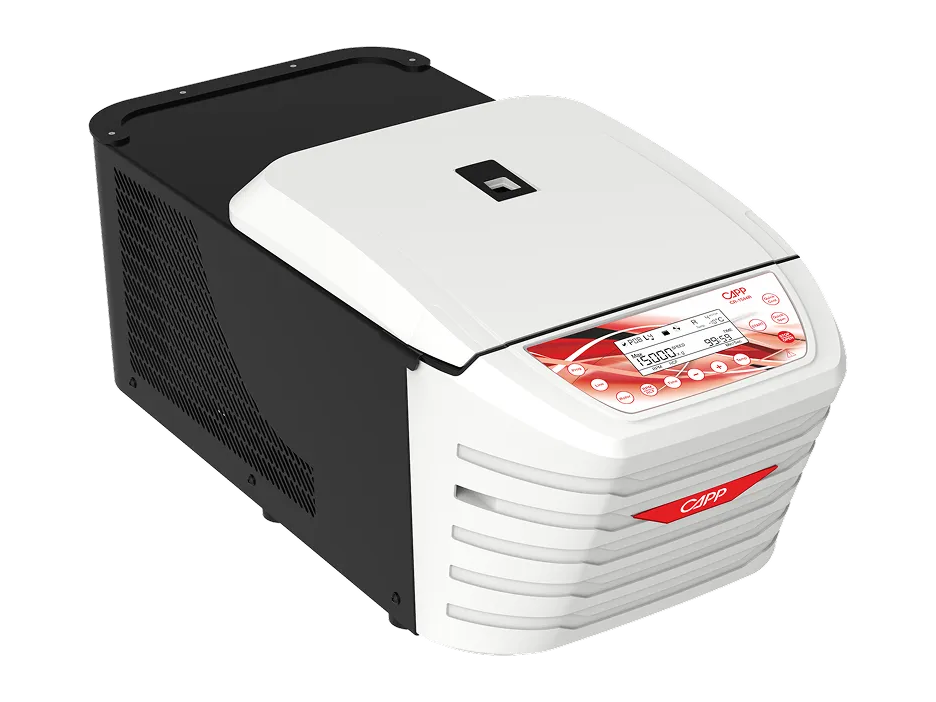
Description
Benefits of Refrigerated Centrifuge That Support Everyday Laboratory Work
Flexible Sample Handling
Different protocols call for different tube formats. That’s why the CAPPRondo comes with four interchangeable rotor options, letting users work with 1.5 mL and 2 mL microcentrifuge tubes, 5 mL microcentrifuge tubes, and PCR strips. This makes it easy to set up the centrifuge around whatever a particular workflow demands.
Temperature Control During Centrifugation
A built-in refrigeration system lets the centrifuge run at temperatures as low as -20°C. Temperature, along with speed and time, can be adjusted directly through the backlit LCD display.
Simple, Programmable Operation
The control panel gives users direct access to key operating parameters. With up to 99 user-defined programs, each holding four lines of settings, frequently used protocols can be saved for repeatable, consistent runs. The timer ranges from 30 seconds up to 999 minutes, or can be set to run indefinitely.
Designed With Safety in Mind
Imbalance detection flags uneven rotor loading before it becomes an issue, while the lid-lock mechanism keeps the centrifuge inaccessible while the rotor is spinning. Together, these features help keep routine operation secure.
How Is This Refrigerated Centrifuge Different?
The CAPPRondo brings several operating requirements together in a single benchtop system. Its interchangeable rotor configuration offers flexibility across tube formats, while a maintenance-free brushless DC motor supports speeds of up to 15,000 RPM. A sturdy 43 kg frame with rubber feet keeps the unit stable during high-speed runs.
By combining refrigeration, programmable settings, multiple rotor choices, and built-in safety features, the CAPPRondo offers a practical option for labs managing a range of centrifugation protocols.
Applications of Refrigerated Centrifuge Across Laboratory Settings
Clinical laboratories: Well-suited to workflows that require both temperature control and support for different sample formats.
Research laboratories: Programmable operation and interchangeable rotors provide the flexibility needed for varied research protocols involving microcentrifuge tubes and PCR strips.
Industrial laboratories: Temperature control, flexible run times, and multiple rotor configurations support a range of routine centrifugation needs.
FAQs
Why is temperature control important during centrifugation?
Temperature-sensitive samples need protection during a spin, and that’s where refrigeration comes in. The CAPPRondo can cool down to -20°C, so labs can hold steady, controlled conditions from start to finish of a run.
Can one refrigerated centrifuge accommodate different sample formats?
Yes — the CAPPRondo works across four interchangeable rotors, covering 1.5/2 mL microcentrifuge tubes, 5 mL tubes, and PCR strips. That means one machine can flex to fit different protocols instead of needing separate units.
How does programmable operation improve centrifugation workflow consistency?
With room to store up to 99 user-defined programs, frequently used protocols can simply be saved and pulled up again later. That cuts down on manually re-entering settings each time and keeps routine runs consistent.
What safety features should laboratories consider when selecting a refrigerated centrifuge?
Two things worth looking for are imbalance detection and a lid-lock. The CAPPRondo picks up on uneven rotor loading and keeps the rotor locked away from users while it’s still spinning.
What makes a refrigerated centrifuge suitable for high-speed laboratory applications?
Speed on its own isn’t enough — it needs to be backed by stability, temperature control, and a dependable motor. The CAPPRondo hits up to 15,000 RPM, runs on a maintenance-free brushless DC motor, and sits on a 43 kg frame with rubber feet to stay steady during high-speed runs.